Be on the lookout for scammers! Never share your log-in details, bank card numbers, or PIN codes. BCV will never ask you for this information. Always double-check your payment orders (payee’s name, amount). Never install remote access software on your devices. Learn more

BCV-net and BCV Mobile will be unavailable on Saturday 08 March from 10h30 pm until Sunday 09 March 05:00 am due to server maintenance. We apologize for the inconvenience, and thank you for your patience.

Environment


We are committed to preserving the environment and continuing our efforts to reduce the environmental footprint of our operations.

Measuring and reducing our carbon footprint

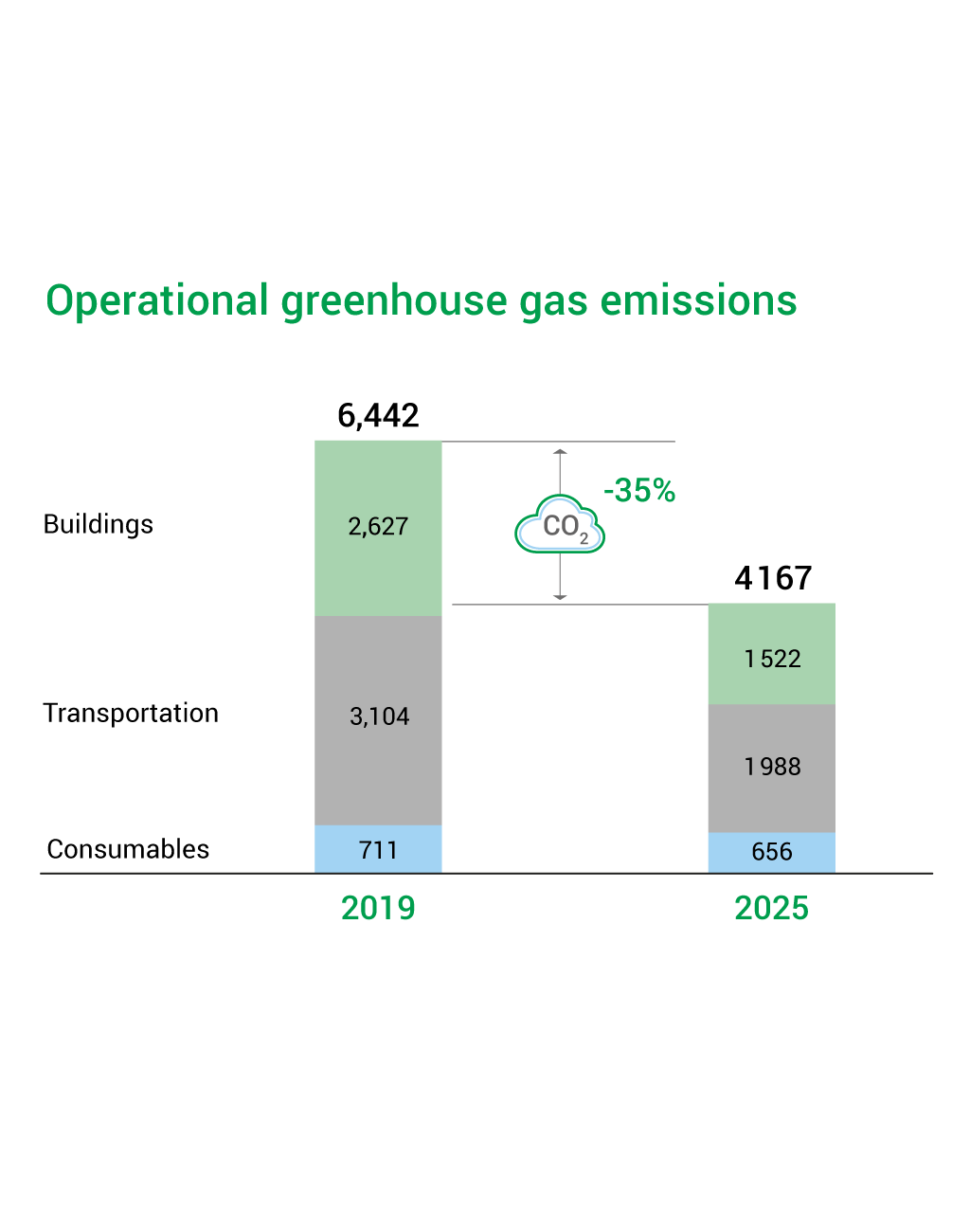
We aim to reduce our operational greenhouse gas (GHG) emissions in line with the Swiss federal government’s goal of reaching net-zero by 2050. We have set an interim target of shrinking our carbon footprint by at least 35% from 2019 levels by 2030.

Our end-2025 operational GHG emissions assessment showed that we emitted 4,167 metric tons of CO2 equivalent (tCO2e) last year, which is 35% lower than 2019 levels. This means that we have met our emissions-reduction goal ahead of the 2030 target date.

Concrete measures

Transportation

  • Rolling out a new employee commuting and business travel plan
  • Paying commuter benefits to staff who travel to work by foot, bike, kick scooter (including electric scooters), electric motorcycle or moped, or public transport (including staff who use park-and-rides but take public transport for the majority of the distance)

Buildings

  • Improving energy efficiency: installing LED lighting and energy-efficient glazing, improving insulation, upgrading elevators, and replacing ventilation fan motors
  • Reorganizing our data centers to make cooling and heat removal more efficient and reduce air-conditioning demand
  • Switching to renewable heating sources, including district heating networks
  • Contributing to the development of renewable energies by installing solar panels

Consumables

  • Introducing a hardware renewal policy under which non-critical equipment is no longer replaced automatically
  • Reducing our computer count under SmartWork, our workspace upgrade initiative
  • Using Blue Angel-certified recycled paper
  • Reducing paper consumption: shifting to electronic versions of documents for use inside the Bank, raising employee awareness about paper consumption via personalized reports showing how much paper each employee uses for printing, and drawing up a short guide on responsible printing practices

Climate-protection projects

In addition to the measures we are taking to reduce our carbon footprint, we finance projects with positive social and environmental impacts in Vaud and outside Switzerland that offset the equivalent amount of GHG emissions associated with our operations. These projects, selected by our partner Swiss Climate, are certified to internationally recognized standards.

On-farm biogas plant in Vaud

Farms generate vast quantities of manure, which, as it ferments, releases methane – a greenhouse gas 28 times more potent than carbon dioxide. With on-farm biogas plants, the fermentation process is carefully controlled, and the resulting methane is collected and piped to a cogeneration plant to produce both heat and electricity.

BCV provides financial support to two biogas facilities located in the Canton of Vaud: EnerBroye and BGA Martin. The EnerBroye facility supplies the Vaud grid with 6.7 million kilowatt-hours (kWh) of electricity annually, enough to power around 1,700 households for a year. Around 4,7 million kWh of residual heat per year is used in nearby factories and to sanitize food waste. The second facility, BGA Martin, generates 1.3 million kWh of electricity and 360,000 kWh of residual heat per year.

These projects, which are ISO 14064-2 certified, save around 4,400 tCO2e per year. Because on-farm biogas plants provide a year-round source of renewable energy, they help reduce the dependency of Swiss farmers on imported fossil fuels while actively supporting sustainable development in the region.


Water filters in Cambodia

In Cambodia, nearly two million rural households do not have access to safe drinking water. To reduce the incidence of disease, it is common practice to boil water on wood or charcoal fires before drinking it. The wood used for this purpose comes from the surrounding tropical forests, which are under threat, contributing to the already high rate of deforestation. Around 30% of Cambodia's forest area has been destroyed in the last 20 years.

This Gold Standard-certified project provides the local population with ceramic filters for water treatment, reducing the consumption of climate-damaging fuels. Since its inception in 2010, the project has avoided around 1 million tCO2e . It also gives more than two million people in Cambodia access to clean and safe drinking water thanks to this alternative water treatment method. In addition, the project has created over 100 jobs, particularly for women, in the local ceramic water filter production plant.

Responsible, local sourcing

At BCV, we make it a point to source locally.

  • Swiss and Vaud-based companies account for nearly 90% of our procurement spend.
  • We work with a large pool of facilities management contractors and regularly switch between suppliers.
  • Each year, we source supplies and services from over 600 businesses based in our Canton.

In this way, we both contribute to the local economy and limit our impact on the environment. Our commitment to local sourcing is reflected in our procurement policy.

In addition, all of our suppliers are expected to comply with the fundamental principles set out in the Social and Environmental Charter for BCV Suppliers.